








Last updated: August 17, 2026
Quick Answer
Ontario convenience stores cannot display vape products in any way that lets customers see them, even behind the counter. Under the Smoke-Free Ontario Act, 2017 and its General Regulation (O. Reg. 268/18), non-specialty retailers must keep all vapour products completely hidden from view. Open shelves, glass cabinets, and back-wall racks are all non-compliant. Only registered specialty vape shops may openly display vaping products, and even those displays must be invisible from outside the store.
Key Takeaways
- All vape products must be fully concealed in Ontario convenience stores. “Behind the counter” does not mean “visible behind the counter.”
- Open shelves, glass display cases, and lit product racks behind the register are not legal, even if customers cannot physically reach them.
- Only registered specialty vape stores may openly display vapour products, and their displays cannot be seen from outside.
- Convenience stores may use text-only product lists (brand name, format, price) with no logos, colours, or product images.
- Staff may retrieve a product from a closed cabinet only after a customer specifically requests it and only immediately before sale.
- Flavour restrictions also apply: convenience stores can stock only tobacco, mint, and menthol flavours, with a maximum nicotine concentration of 20 mg/mL.
- Fines for display violations can reach up to $100,000 for a first offence for individuals and up to $300,000 for corporations under the SFOA.
- Federal rules under the Tobacco and Vaping Products Act add another layer, banning any display visible to young persons at point of sale.
- Municipal licensing may impose additional conditions and penalties beyond provincial law.
- Inspections are complaint-driven and routine; tobacco enforcement officers can enter retail premises without a warrant during business hours.
What Are the Legal Requirements for Vape Displays in Ontario Convenience Stores?
Ontario law requires convenience stores to keep every vapour product completely out of sight. The Smoke-Free Ontario Act, 2017 (SFOA) and its General Regulation, O. Reg. 268/18, make no exception for “behind-the-counter” placement. If a customer walking into the store can see the product, the display is illegal.

Here is what the law specifically requires of non-specialty retailers:
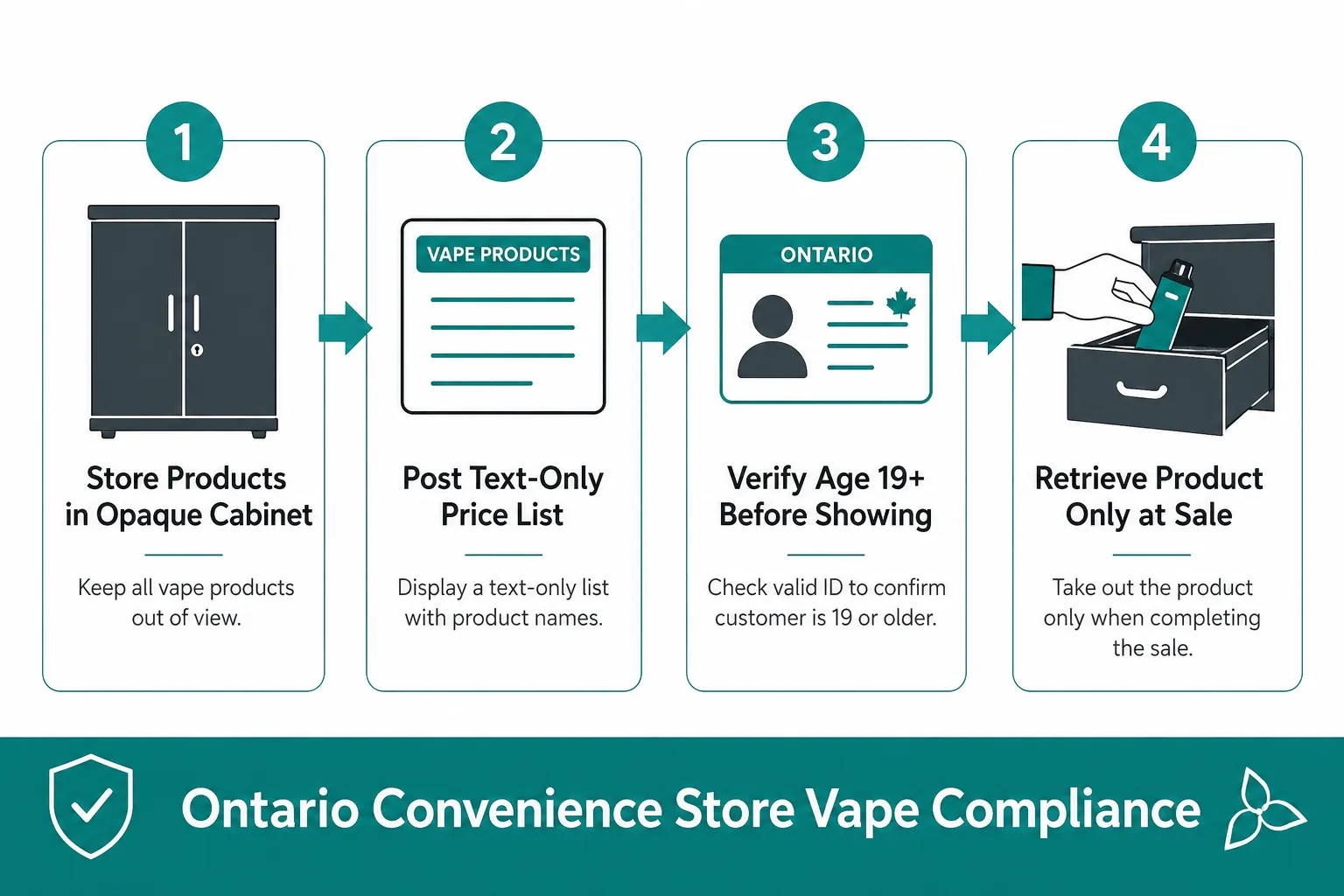
- Total concealment. Vape products must be stored in opaque cabinets, drawers, or enclosed storage that prevents any customer from viewing them.
- No promotional displays. Posters, digital signage, window ads, and branded shelf talkers for vaping products are banned in convenience stores and gas stations. This has been the case since January 2020.
- Text-only communication. Stores may provide a simple list showing brand names, product formats, and prices. No logos, brand colours, or product images are allowed.
- Retrieve on request only. Staff can take a product out of concealed storage only when a specific adult customer asks for it, and only immediately before completing the sale. The product cannot stay on the counter for browsing.
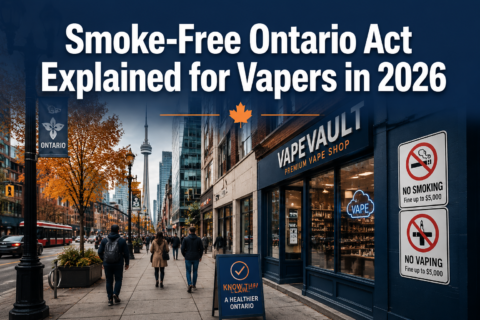
For a full breakdown of how the SFOA applies to vapers and retailers, see the Smoke-Free Ontario Act explained for vapers in 2026.
Common mistake: Many store owners assume that placing vapes on a shelf behind the cash register counts as “hidden” because customers can’t reach them. It does not. Visibility is the test, not accessibility. If the product packaging is visible from any customer-accessible area, the store is in violation.
Can You Display Vapes Behind the Counter in Ontario, or Do They Have to Be Hidden?
They have to be hidden. The phrase “behind the counter” is misleading because it implies that physical distance from the customer is enough. Under Ontario law, the standard is visibility, not proximity. A vape product sitting on an open shelf behind the register is just as illegal as one sitting on the front counter.
Acceptable storage methods include:
- Solid-door cabinets mounted on the back wall
- Under-counter drawers that remain closed
- Opaque bins or containers stored below the counter line
- Stockroom storage with products brought out only at the point of sale
Unacceptable methods include:
- Glass-front display cases (even if locked)
- Open shelving behind the register
- Slatwall displays with product hooks visible to customers
- Transparent countertop cases
If you’re setting up a new store, the step-by-step guide to becoming a vape retailer in Ontario covers the full licensing and compliance process, including display requirements.
What’s the Difference Between Legal and Illegal Vape Display Rules in Ontario?
The line between legal and illegal comes down to one question: can any person in the store see the product? If yes, it’s illegal in a convenience store. If no, it’s legal.
Here is a comparison to make the distinction clear:
| Element | Legal (Compliant) | Illegal (Non-Compliant) |
|---|---|---|
| Product storage | Opaque cabinet, closed drawer, stockroom | Open shelf, glass case, countertop rack |
| In-store signage | Text-only list (brand, format, price) | Posters, branded displays, digital ads |
| Product retrieval | Taken out only after a specific customer request, immediately before sale | Left on counter for browsing, shown to undecided customers |
| Promotional material | None permitted in convenience stores | Window stickers, shelf talkers, branded price tags with logos |
| Flavour visibility | Only tobacco, mint, and menthol stocked; hidden | Fruit or candy flavours on display (illegal to stock AND display) |
Decision rule: If you’re unsure whether your setup is compliant, stand in the customer area and look toward the counter. If you can identify any vape product by its packaging, shape, or brand, it needs to be concealed.
How Much Do Fines Cost If You Display Vapes Wrong in an Ontario Store?
Penalties under the SFOA are steep and escalate with repeat offences. For individuals (including sole proprietors), a first offence can result in a fine of up to $100,000. For corporations, the maximum first-offence fine is up to $300,000.
Here’s what the penalty structure looks like:
- First offence (individual): Up to $100,000
- First offence (corporation): Up to $300,000
- Subsequent offences: Higher maximums, plus the possibility of licence suspension or revocation
- Automatic prohibition orders: Courts can prohibit the sale of vapour products for a set period
Beyond provincial fines, municipalities with their own tobacco and vaping retailer licensing programs can impose additional penalties, including licence suspension, conditions on renewal, or outright revocation. Some Ontario municipalities have implemented licensing frameworks that specifically reference SFOA display and promotion rules as conditions of the licence.
Edge case: Even if a store is not fined immediately, an inspection report noting a display violation can trigger problems during licence renewal. Some municipal licensing offices treat any recorded SFOA violation as grounds to add conditions or delay renewal.
For retailers concerned about margins while staying compliant, the guide on wholesale disposable vape margins for Ontario retailers covers how to maintain profitability within legal constraints.
What Does the Smoke-Free Ontario Act Say About Vape Product Visibility?
The SFOA treats vapour products similarly to tobacco when it comes to display and promotion in non-specialty retail. The Act and its regulations establish that convenience stores, gas stations, and grocery stores may not display vapour products in any manner visible to the public.
Key provisions include:
- Section 3 of O. Reg. 268/18 confirms that non-specialty retailers cannot display vapour products.
- Promotion ban (since January 2020): No advertising of vaping products in convenience stores or gas stations. This includes posters, counter cards, window decals, and digital screens.
- Specialty store exception: Only stores that meet the province’s definition of a registered specialty vape store may display products openly, and even then, displays must not be visible from outside and no one under 19 may enter.
- Retailer guidance documents used by enforcement officers specify that “hidden from view” means opaque enclosures, not just physical barriers.
The SFOA also works alongside federal law. The federal Tobacco and Vaping Products Act (TVPA) and the Vaping Products Promotion Regulations (SOR/2020-143) prohibit displaying vaping products at the point of sale in any way visible to young persons. In practice, this federal layer reinforces Ontario’s rules and closes any theoretical loophole about displaying products only to adults in a mixed-age retail environment.
Are There Age Restrictions on Who Can See Vape Products in Ontario Shops?
Yes. Both provincial and federal law are designed to prevent anyone under 19 from seeing, accessing, or purchasing vape products. In Ontario, the legal age to buy vapour products is 19. The rules go beyond just selling: they restrict visibility itself.
- Convenience stores must hide all vape products from everyone, regardless of age, because these stores serve all age groups.
- Specialty vape stores may display products openly but must prohibit entry to anyone under 19 and ensure displays are not visible from outside.
- Federal law specifically bans displaying vaping products at point of sale in any way that allows young persons to see them.
What this means in practice: A convenience store cannot argue that its vape display is legal because it’s “only visible to adults.” The store has no mechanism to prevent minors from seeing products on open shelves. That’s precisely why full concealment is required.
For more on Ontario’s age-related vaping rules and consequences, see what happens if you get caught vaping underage in Ontario.
Do All Convenience Stores in Ontario Follow the Same Vape Display Rules?
Yes, the provincial rules apply uniformly to every non-specialty retailer in Ontario, regardless of location, store size, or sales volume. A corner store in Thunder Bay faces the same display requirements as a large chain gas station in downtown Toronto.
However, there are two important layers of variation:
Municipal licensing. Some municipalities have their own tobacco and vaping retailer licensing programs. These can add requirements on top of the SFOA, such as minimum distances between vape retailers, additional signage rules, or stricter inspection schedules. A store in a municipality with its own licensing program may face more frequent compliance checks.
Enforcement intensity. While the rules are the same everywhere, enforcement resources vary. Urban areas with dedicated public health inspection teams may see more frequent visits than rural areas. This does not change the legal standard, but it affects how quickly violations are caught.
Bottom line: No convenience store in Ontario is exempt from the display ban. The rules don’t change based on how long the store has been open, how few vape products it sells, or whether it’s in a low-traffic area.
What Happens If You Get Caught Displaying Vapes Illegally in Ontario?
Getting caught triggers a formal enforcement process that can escalate quickly. Tobacco enforcement officers, who also cover vapour products, have the authority to enter any retail premises during business hours without a warrant to inspect for compliance.
Here’s the typical enforcement sequence:
- Inspection and documentation. The officer photographs the violation, notes the specifics, and may interview staff.
- Warning or charge. Depending on the severity and whether it’s a first occurrence, the officer may issue a warning, a provincial offence ticket, or lay a charge under the SFOA.
- Court proceedings. If charged, the case goes to provincial offences court. Convictions result in fines and can include prohibition orders.
- Licence consequences. A conviction or even a documented violation can affect municipal licence renewal. Some municipalities automatically review licences after any SFOA-related charge.
- Repeat offence escalation. Second and subsequent offences carry higher fines and longer prohibition periods.
Quick example: A convenience store owner in the GTA installs a glass-front cabinet behind the counter to display vape products neatly. An enforcement officer visits, photographs the visible products, and issues a charge. Even though the products were behind glass and behind the counter, the display is illegal because customers could see the packaging. The owner faces a potential fine of up to $100,000 and a note on their licensing record.
Are Flavoured Vapes Displayed Differently Than Regular Vapes in Ontario?
No, because convenience stores cannot display any vapes at all. But the flavour question matters for a different reason: convenience stores in Ontario can only sell tobacco, mint, and menthol flavoured vape products. Fruit, candy, dessert, and other flavours are restricted to specialty vape stores.
This means:
- A convenience store caught with fruit-flavoured vapes in stock is violating the flavour restriction, regardless of whether the products are hidden or displayed.
- A convenience store that displays mint-flavoured vapes on an open shelf is violating the display rule, even though the flavour itself is permitted.
- Both violations can be charged separately, compounding fines.
For a detailed look at which flavours are allowed where, see mint, menthol, and tobacco: the only flavours allowed in Ontario convenience stores.
Nicotine cap: Convenience stores also cannot sell vape products with nicotine concentrations above 20 mg/mL. This further limits what can legally be stocked, even in concealed storage.
Can You Display Vapes on Shelves or Only Behind the Counter in Ontario?
In a convenience store, you cannot display vapes on shelves, behind the counter, on the counter, in a window, or anywhere else that a customer can see them. The answer is neither open shelves nor behind-the-counter displays. The only legal option is complete concealment in opaque, closed storage.
Here’s a quick reference for what works:
Acceptable storage locations:
- Closed wooden or metal cabinets behind the counter
- Drawers below the counter surface
- A locked stockroom or back office (products brought to the counter only at the moment of sale)
- Opaque containers or bins that fully conceal the product
Not acceptable:
- Any shelf visible to customers, whether in front of or behind the counter
- Pegboard displays on the back wall
- Countertop spinner racks
- Refrigerated display cases with vape products visible through glass
Which Ontario Stores Are Exempt from Vape Display Regulations?
The only retail category exempt from the full concealment rule is registered specialty vape stores. These are stand-alone retail locations that meet specific provincial criteria:
- The store’s primary business is selling vapour products.
- No person under 19 is permitted to enter.
- The store is a separate, enclosed retail space (not a section within a convenience store or gas station).
- All displays and promotions of vapour products are not visible from outside the store.
Cannabis retail stores in Ontario can also display and promote vaping products, but only under their own regulatory framework administered by the Alcohol and Gaming Commission of Ontario (AGCO).
No other retail category receives an exemption. Pharmacies, grocery stores, big-box retailers, and convenience stores all fall under the full concealment requirement if they choose to sell vapour products.
Edge case: A convenience store owner who also operates a specialty vape store must keep the two businesses physically separate. A shared space, shared entrance, or shared counter does not qualify for the specialty store exemption.
How Often Do Ontario Inspectors Check Vape Display Compliance?
There is no fixed public schedule for inspections. Tobacco enforcement officers conduct both routine inspections and complaint-driven visits. The frequency depends on available resources, local public health priorities, and the volume of complaints in a given area.
What retailers should know:
- Routine inspections happen as part of broader tobacco and vaping enforcement sweeps. Some public health units conduct these annually; others do them more frequently.
- Complaint-driven inspections can happen at any time. A single complaint from a customer, competitor, or community member can trigger a visit.
- Officers can enter without a warrant during normal business hours. They do not need to give advance notice.
- Mystery shopper programs are used in some jurisdictions to test age-verification compliance. These visits may also note display violations.
Practical advice: Assume an inspection could happen on any business day. The cost of maintaining compliant storage (opaque cabinets, drawers) is minimal compared to the cost of a single fine.
For help setting up compliant retail operations, the guide on vape shop display rules in Ontario covers practical strategies for staying within the law while still serving customers effectively.
What’s the Most Common Mistake Stores Make with Vape Displays in Ontario?
The single most common mistake is treating “behind the counter” as compliant by default. Many store owners install shelving or racks behind the cash register, stock them with vape products, and assume the physical counter creates enough separation. It does not.
Other frequent mistakes include:
- Leaving cabinet doors open during business hours. Even if the store owns opaque cabinets, propping the doors open for convenience defeats the purpose and creates a violation.
- Using branded price signs. A price list that includes brand logos, product images, or coloured backgrounds crosses the line from permitted text-only communication into illegal promotion.
- Displaying empty packaging. Some stores display empty vape boxes as a “menu” for customers. Empty or not, visible branded packaging counts as a display.
- Stocking restricted flavours. Keeping fruit-flavoured vapes in the back for “regulars” is a product violation, not just a display issue.
- Failing to check IDs before showing products. Staff must verify that a customer is 19 or older before retrieving any vape product from storage. Showing a product to an unverified customer is a compliance risk.
Rule of thumb: If a customer can learn what vape brands you carry by looking around your store (without asking), something is wrong.
Are Online Vape Sales Subject to the Same Display Rules as Physical Stores in Ontario?
Online vape sales operate under a different but overlapping set of rules. The physical display requirements of the SFOA apply to brick-and-mortar retail spaces, so the concept of “hidden from view” doesn’t translate directly to a website. However, online sellers face their own strict regulations:
- Federal law (TVPA) prohibits vaping product advertising and promotion that could reach young persons, including online.
- Age verification is required before any online purchase can be completed. Ontario’s framework requires robust age-gating, not just a checkbox.
- Flavour and nicotine restrictions still apply. An Ontario-based online retailer cannot sell fruit-flavoured vapes to Ontario customers, just as a convenience store cannot stock them.
- Promotion restrictions carry over. Lifestyle imagery, testimonials, and advertising that could appeal to youth are banned federally, regardless of the sales channel.
For a deeper look at how online purchasing works within Ontario’s legal framework, see buying vapes online in Ontario: age verification, delivery, and legal shopping.
Key distinction: A physical store’s website showing product images is not the same violation as an in-store display, but it can still violate federal promotion rules if the images are accessible to minors or use restricted advertising techniques.
Compliance Checklist for Ontario Convenience Store Vape Displays
Use this checklist to audit your store’s setup:
- All vape products are stored in fully opaque, closed cabinets or drawers
- No vape product packaging is visible from any customer-accessible area
- Cabinet doors remain closed at all times during business hours
- In-store product lists are text-only: brand name, format, and price, with no logos or images
- No posters, window decals, digital ads, or branded materials for vaping products are displayed anywhere in the store
- Only tobacco, mint, and menthol flavoured vapes are in stock
- No products exceed 20 mg/mL nicotine concentration
- Staff verify customer age (19+) before retrieving any vape product from storage
- Products are retrieved only after a specific customer request and returned to concealed storage if the sale is not completed
- All products carry valid federal excise stamps
For help verifying that your stock is legal, the guide on federal excise stamps on Canadian vapes explains what to look for.
FAQ
Can I put vapes in a locked glass case behind my counter?
No. A locked glass case still allows customers to see the products. Ontario law requires full concealment, meaning the storage must be opaque. Glass cases, even locked ones, do not meet this standard.
What if I only sell to adults? Can I display vapes then?
No. Convenience stores serve all ages, and there is no practical way to prevent minors from seeing products on display. The display ban applies regardless of your customer base.
Can I have a vape menu with product photos?
No. In-store materials in convenience stores must be text-only. Brand names, product formats, and prices are allowed. Logos, product photos, and coloured branding are not.
Do the same rules apply to tobacco product displays?
Yes. Tobacco products in Ontario convenience stores must also be completely hidden from view. The display rules for tobacco and vapour products are essentially identical in non-specialty retail.
Can I display vape accessories like chargers or cases?
Accessories that are not themselves vapour products (such as generic USB chargers) are generally not covered by the SFOA display ban. However, branded vape accessories that feature product logos or branding could be considered promotional material and should be treated cautiously.
What counts as a “specialty vape store” in Ontario?
A specialty vape store is a stand-alone retail space whose primary business is selling vapour products, where no person under 19 is allowed to enter, and where all product displays are not visible from outside. A section of a convenience store does not qualify.
How do I know if my municipality has extra vape display rules?
Contact your municipal licensing office or local public health unit. Many Ontario municipalities publish their tobacco and vaping retailer licensing requirements online. These can include conditions beyond the provincial SFOA requirements.
Can I display empty vape boxes as samples?
No. Empty branded packaging is still considered a display of a vapour product under enforcement guidance. It must be concealed just like a full product.
What if an inspector finds a single vape product left on the counter by accident?
Intent does not change the violation. If a product is visible during an inspection, it can be documented as a display violation. Train staff to immediately return products to concealed storage after every transaction.
Are disposable vapes treated differently from refillable devices?
No. The display rules apply to all vapour products equally, whether disposable, refillable, pod-based, or any other format.
Can I advertise vape products on a sign outside my store?
No. Exterior signage, window displays, and outdoor advertising for vaping products are prohibited at convenience stores and gas stations in Ontario.
Do I need a special licence to sell vapes in Ontario?
Ontario does not currently require a provincial vape-specific retail licence, but many municipalities require a local tobacco and vaping retailer licence. Check with your local government. Federal excise requirements also apply to the products themselves.
Conclusion
Ontario’s rules on vape displays in convenience stores are strict but straightforward: every vapour product must be completely hidden from customer view at all times. There is no exception for behind-the-counter placement, locked cases, or adult-only hours. The law tests visibility, not accessibility.
For convenience store owners and managers, the actionable steps are clear:
- Install opaque, solid-door cabinets or use enclosed drawers for all vape product storage.
- Remove all branded signage, posters, and promotional materials for vaping products from the store.
- Create a text-only product list if you want customers to know what you carry.
- Train every staff member to verify age before retrieving products and to return unsold items to concealed storage immediately.
- Audit your stock to confirm you’re only carrying tobacco, mint, and menthol flavours at or below 20 mg/mL nicotine.
- Check municipal requirements for any additional licensing conditions in your area.
The fines for non-compliance are significant, reaching up to $100,000 for individuals and $300,000 for corporations on a first offence. But the cost of compliance, a few opaque cabinets and proper staff training, is minimal by comparison. Getting this right protects your business, your licence, and your ability to serve adult customers legally.